
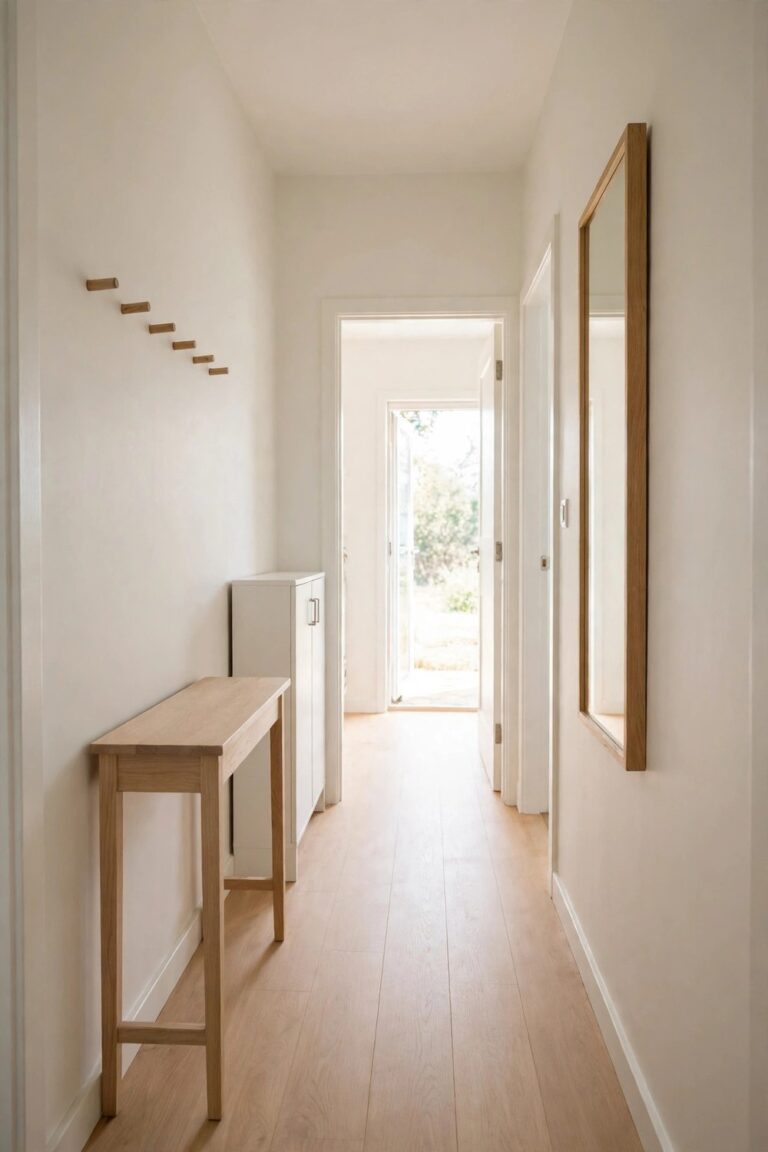

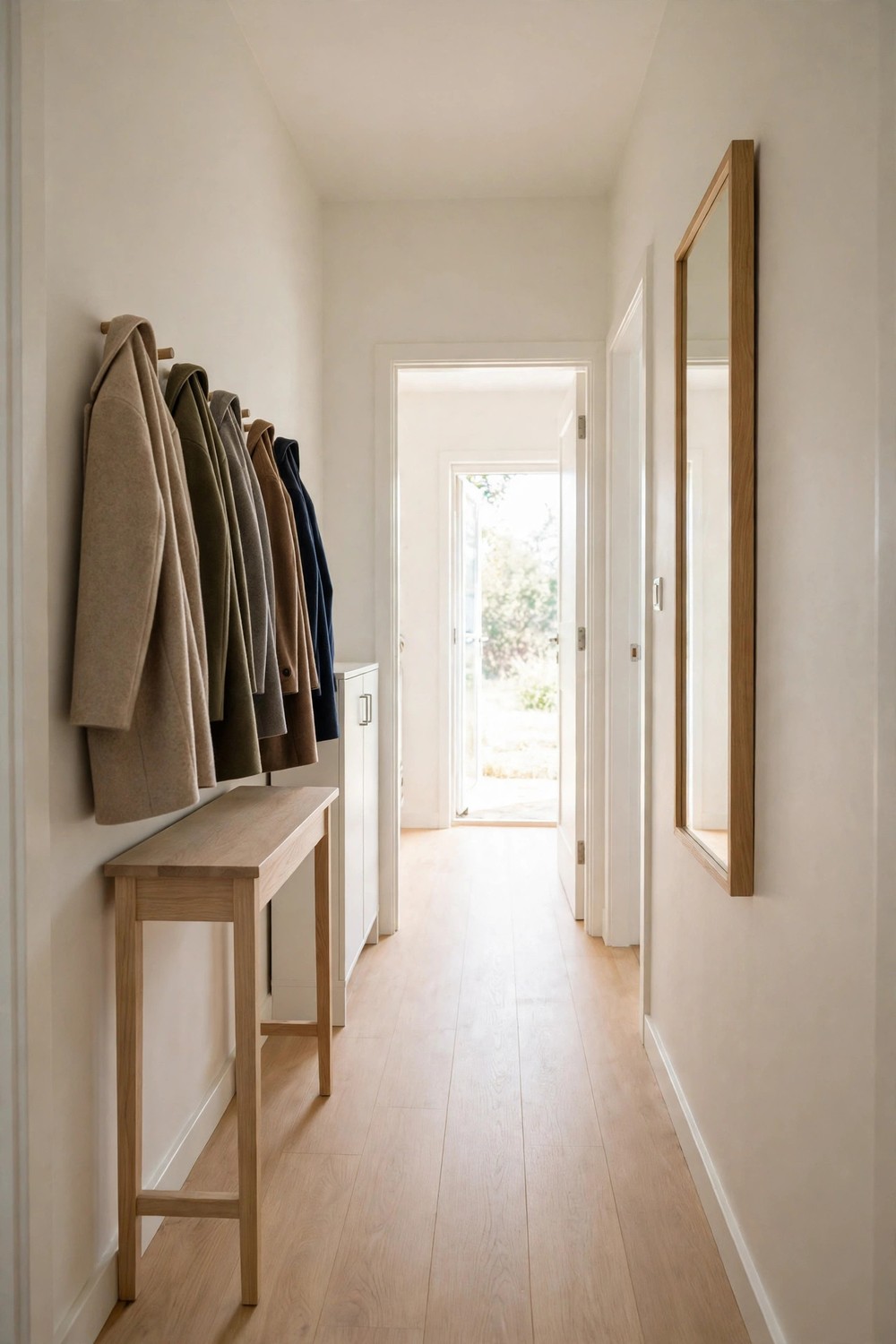
Hallway storage ideas for narrow spaces start with one rule: the walkway is not storage. In a narrow hallway, every centimetre of floor is walking space, and the moment a pair of shoes or a bag lands on it, the hallway stops working. The fix is not a bigger hallway. It is moving everything off the floor and onto the walls — slim furniture, wall pegs, one clear path from the door to the rest of the home — so the narrow hallway holds everything it needs to hold without feeling cramped.
Keep the walkway clear
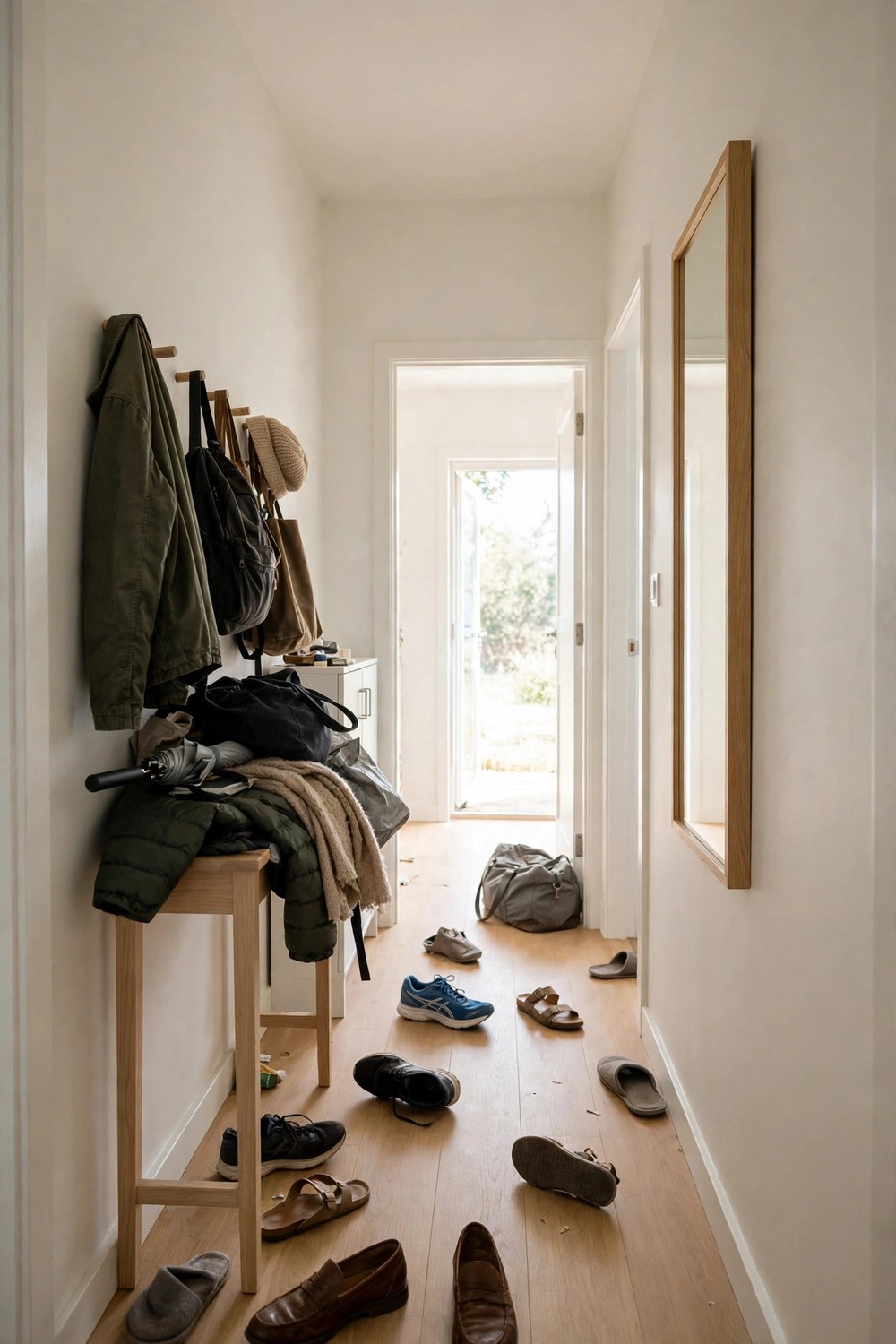
A narrow hallway works when you can walk down it without thinking. That means the floor holds nothing at all: no shoes, no bags, no pile of things waiting to go somewhere else. Everything that used to live on the floor gets a place on the wall or inside a slim piece of furniture, and the walkway stays clear from the door to the far end. Measure the width first — the furniture has to leave enough room to walk past it comfortably, even carrying a bag of shopping. If you have to turn sideways to get past a shoe rack, the rack is too deep. (If the whole home needs the same treatment, the thirty-minute daily declutter is the place to start.)

Think up, not out
Hallway storage ideas for narrow spaces work best when the walls do the work the floor was doing. A row of pegs by the door takes the coats and the bags, and the floor stops being the wardrobe. One peg per coat, hung at a height everyone in the house can reach — the coat you wear every day on the easiest peg, the spare coat on the highest one. If the pegs are full, something leaves: a peg with a job stays tidy, a peg that holds a bit of everything becomes the pile on the wall. A slim shelf above the pegs holds a plant and a small basket, and it is the difference between a hallway that works and a hallway that looks finished. Keep it light: a shelf that holds too much becomes another pile, and a pile above the door is worse than a pile on the floor.
One pair of shoes per person
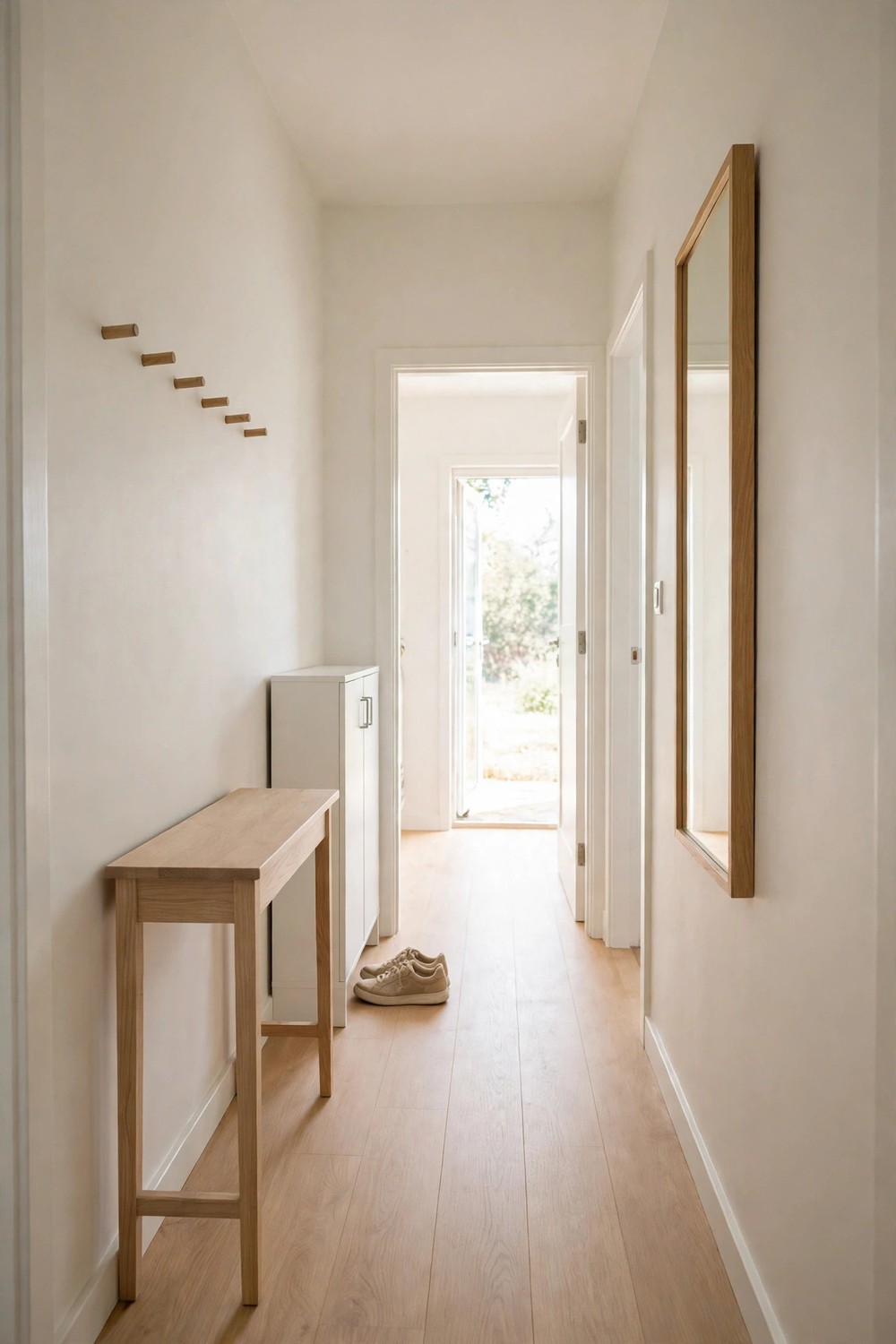
Shoes are the reason a narrow hallway feels messy, even when everything else is tidy. A slim shoe cabinet against the wall holds the shoes behind a door, and the walkway stays clear — nothing to trip over, nothing to step around in the dark. One pair per person inside the cabinet, the rest in the cupboard: the shoes you wear every day live by the door, the shoes you wear once a month live somewhere else. A cabinet with doors beats an open rack in a narrow hallway, because closed doors read as wall and open shelves read as clutter. If there is no room for a cabinet at all, a low tray under the console holds one pair each and nothing more. (If the bedroom needs the same treatment, small bedroom storage ideas shows where the rest of the shoes belong.)

A place for the small things
The small things are the ones that disappear. A small basket on the console holds the keys, the post and the sunglasses, and it is the first thing you reach for on the way out and the first thing you drop into on the way in. One basket, not three: a basket with one job stays tidy, a shelf that holds a bit of everything becomes the pile by the door. Put the basket where your hand already reaches when you step inside — if you have to think about where it is, it is in the wrong place. The console itself should be as slim as the hallway allows: a table no deeper than a book, against the wall, holding the basket and nothing else. Anything else on the console is something that belongs in another room. (If the flat itself needs the same treatment, small apartment storage ideas shows how the same thinking works room by room.)

Light and mirrors
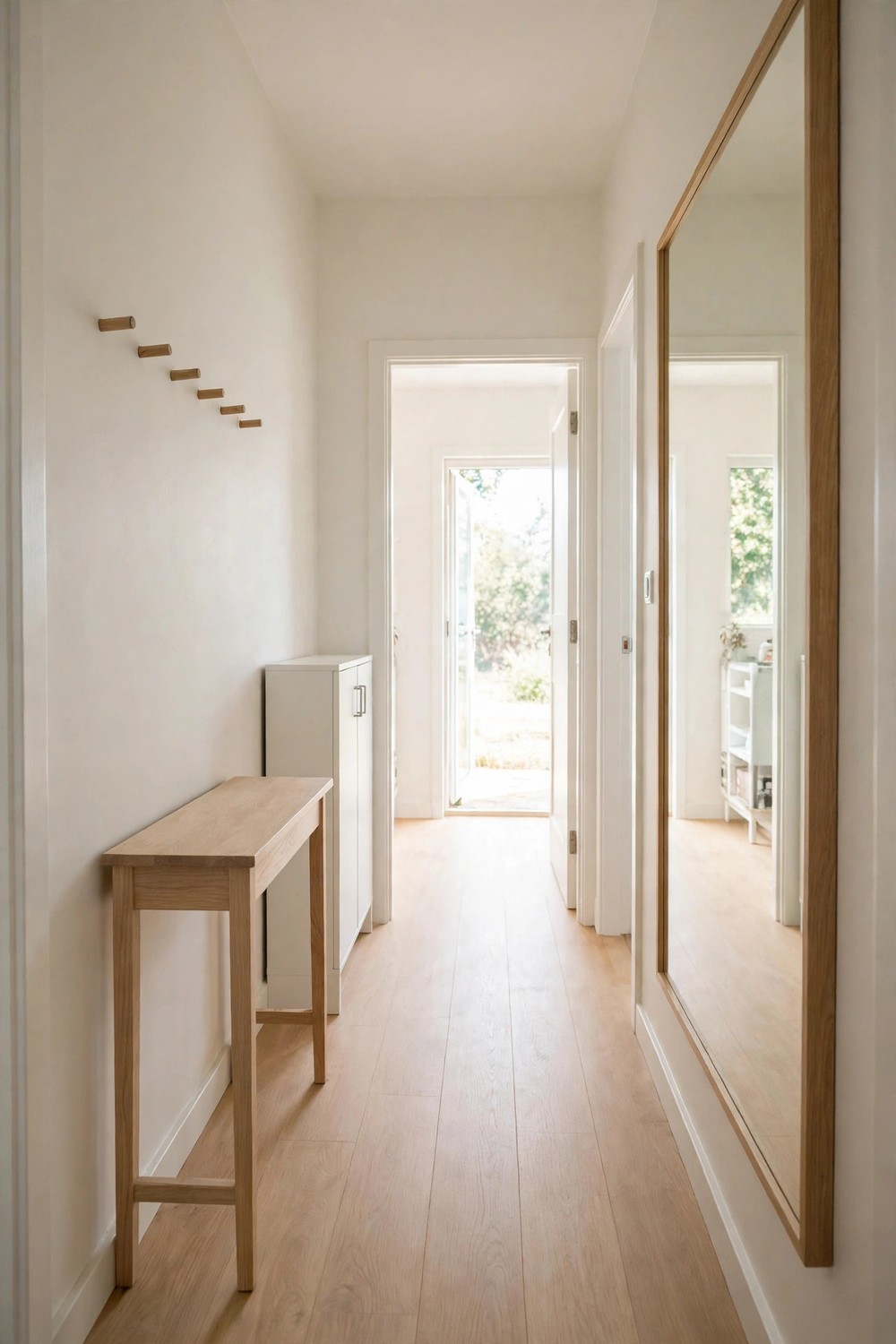
A narrow hallway feels cramped because it is dark as well as small. A tall mirror on the wall bounces the light around and makes the space feel twice as wide, without moving a single wall — and it is useful on the way out, too. Keep the mirror opposite the brightest point in the hallway, so it catches the light from the door or the nearest room. Pale walls help for the same reason: a light wall recedes, a dark wall closes in. None of this is decoration for its own sake. In a narrow space, light is storage — it is what stops the hallway feeling full even when every peg and shelf is in use.
The two-minute reset
A tidy hallway stays tidy by a habit, not by luck. Two minutes at the end of the day: coats on pegs, shoes in the cabinet, keys in the basket, walkway ready for tomorrow. The same two minutes every evening beats a big clear-out on a Saturday, because the hallway never gets the chance to fill up again. A clear walkway makes a small home feel twice as big, and it costs nothing at all — the things that were on it just moved to a peg, a cabinet or a basket that was already there.
Start with the door, not the whole hallway
Do not try to organise the whole hallway in one weekend. Pick the door — the pegs, the cabinet, the basket — and finish it properly: one peg per coat, one pair of shoes per person in the cabinet, one basket for the small things. One finished doorway changes how the whole home feels when you walk in, and it shows you what works before you spend anything on the next bit. A hallway gets easier one doorway at a time.
How do I store shoes in a narrow hallway?
In a slim shoe cabinet with doors against the wall — one pair per person inside, the rest in a cupboard. Closed doors read as wall, so the hallway feels wider than an open rack.
What furniture fits a narrow hallway?
As slim as the hallway allows: a console no deeper than a book, a slim shoe cabinet, and wall pegs and shelves instead of floor-standing furniture. Measure first — you must still walk past it comfortably.
How do I stop a narrow hallway becoming a dumping ground?
Give everything one place that is not the floor: pegs for coats, a cabinet for shoes, one basket for keys and post — plus a two-minute reset each evening so nothing gets the chance to pile up.
For more storage that works in a small home, try the wardrobe organisation ideas for a small wardrobe, and explore the rest of Home Organisation.



0 Comments